
 Proudly Family-Owned
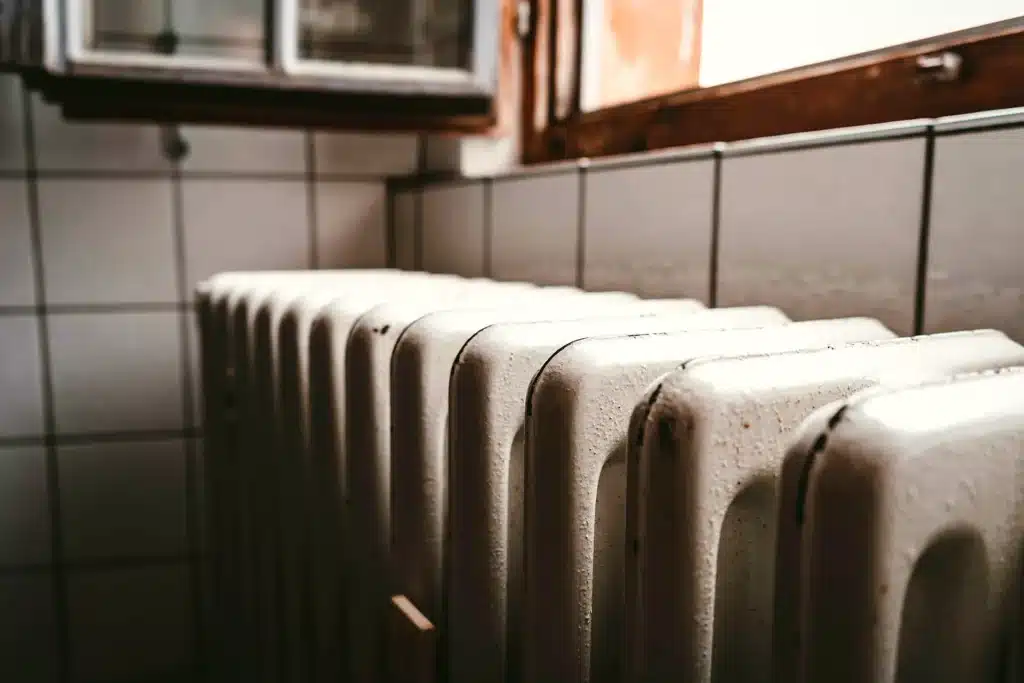
Hot water radiator heating works by heating water in a boiler and pumping it through pipes to radiators in each room. The radiators release that heat into the room through radiation and convection, then the cooled water returns to the boiler to be reheated. It is quiet, even and duct-free heat, common in older Ontario homes.
If you own an older home in Hamilton, there is a good chance it is heated this way. This guide covers how the system works, the types of radiators you are likely to find, how to tell hot water from steam, why a radiator goes cold, how to bleed and balance radiators, and when it is time to call a technician.
How Does Hot Water Radiator Heating Work?
A boiler heats water, a circulator pump moves it through supply pipes to each radiator, and the radiators transfer the heat into the room. The cooled water then flows back through return pipes to the boiler. In most systems the loop is sealed and pressurized, so the same water circulates for years.
Radiators heat a room in two ways. They warm nearby surfaces and people directly through radiant heat, and they warm the air around them, which rises and circulates through the room by convection. That combination is why radiator heat feels steady and even, without the warm-then-cool cycling and air movement of a forced-air furnace. A thermostat tells the boiler when to fire, and in many homes individual radiator valves fine-tune the temperature room by room. Some older homes still run an open system with an expansion tank in the attic rather than a sealed, pressurized loop; a technician can tell you which you have.
Types of Radiators You’ll Find in Older Homes
Most hot water systems use one of four radiator types: cast-iron column radiators, steel panel radiators, finned baseboard convectors or cast-iron baseboards. Older homes often have a mix, because radiators were added or replaced as rooms were renovated. Each type heats differently, which affects comfort and how quickly a room warms up.
| Type | How it heats | Typical traits |
|---|---|---|
| Cast-iron column radiator | Mostly radiant | Heavy, slow to warm and slow to cool; holds heat long after the boiler stops; very durable |
| Steel panel radiator | Radiant and convective | Slim, wall-mounted, heats up quickly; common in renovations and newer installs |
| Finned baseboard convector | Mostly convective | Copper pipe with aluminum fins behind a cover along the wall; fins need keeping clean and straight |
| Cast-iron baseboard | Radiant and convective | Low profile like a convector but with more mass, so it holds heat longer |
None of these types is wrong for a hot water system. What matters is that each room has enough radiator surface for its heat loss, which becomes important if the boiler is ever replaced with a high-efficiency model.
Hot Water or Steam Radiators: How to Tell the Difference
Hot water radiators usually have two pipes, a supply and a return, and a small bleed valve near the top. Steam radiators often have a single pipe and a larger air vent on the side that hisses as the system heats. Steam boilers also have a glass sight tube showing the water level.
The difference matters because the maintenance is different. Hot water radiators are bled to remove trapped air; steam radiators rely on their vents and must not be bled the same way. Steam systems also run at much lower pressure and need different boiler controls. If you are not sure which you have, a technician can confirm it in a few minutes on a service visit, and everything else in this guide assumes a hot water system.
Why Is One Radiator Cold?
A cold or half-warm radiator is usually caused by trapped air, a closed or stuck valve, poor balancing, low system pressure, or sludge settling in the radiator. Where the radiator is cold is the best clue. Cold at the top and warm at the bottom points to air; warm at the top and cold at the bottom points to sludge.
| What you notice | Likely cause | Usual fix |
|---|---|---|
| Cold at the top, warm at the bottom, maybe gurgling | Trapped air | Bleed the radiator |
| Warm at the top, cold at the bottom | Sludge or debris settled inside | Professional flush |
| Completely cold, others are fine | Valve closed, stuck, or a thermostatic valve pin seized | Check the valve; free or replace it |
| Radiators far from the boiler are cooler | System out of balance | Balance the radiators |
| Several radiators cool and pressure gauge is low | Low pressure or a leak | Find the cause before topping up |
| All radiators cold, boiler running | Circulator pump or control fault | Call a technician |
Repeated air in the same radiator is worth noting. A system that keeps collecting air is often drawing in fresh water to replace water lost somewhere else, which points back to a leak. Our guide to a boiler leaking water explains how to trace one.
How to Bleed a Radiator
Bleeding releases trapped air so the radiator can fill completely with hot water. It takes a few minutes per radiator and needs only a radiator key or a flat screwdriver, depending on the valve, plus a cloth. Do it with the heating off, and check the boiler pressure afterwards, because releasing air lowers it.
- Turn the heating off and let the radiators cool, so you are not releasing hot water.
- Find the bleed valve, a small square or slotted fitting near the top corner of the radiator.
- Hold a cloth under the valve and turn it slowly counterclockwise about a quarter to half a turn.
- Listen for hissing air. When water starts to come out steadily, close the valve.
- Repeat on other radiators that show the same symptoms.
- Check the boiler pressure gauge. If it has dropped below the normal range, the system needs topping up; if you are not sure how, leave it to a technician.
- Turn the heating back on and check that the radiators warm evenly.
Natural Resources Canada notes in its Keeping the Heat In homeowner guide that hydronic systems perform best when radiators are relatively free of air and operating at the correct pressure, which means bleeding them regularly unless the system bleeds itself automatically.
Radiator Balancing: Why Some Rooms Heat Faster Than Others
Water takes the easiest path, so radiators closest to the boiler tend to heat first and hottest, while those at the end of the run stay cooler. Balancing adjusts the flow through each radiator so they all warm at a similar rate. It is done with the lockshield valve, the capped valve on the opposite end from the control knob.
Balancing is methodical work: each radiator’s flow is adjusted and its temperature checked until the system heats evenly. It is worth doing after a boiler replacement, after radiators are added or moved, or when some rooms are consistently colder than others despite bleeding. Because over-tightening a lockshield valve can starve a radiator completely, many homeowners prefer to have it done as part of a service visit.
Thermostatic Radiator Valves: Room-by-Room Control
A thermostatic radiator valve, or TRV, replaces the manual knob on a radiator and opens or closes automatically to hold the room at a set level. It lets you keep bedrooms cooler and living areas warmer without changing the main thermostat, which is one of the main comfort advantages of radiator heating over a single-zone furnace.
For a TRV to work properly it needs to sense the room’s air, so it should not be covered by curtains, furniture or radiator covers. The radiator in the same room as the main thermostat is usually left without one, so the two controls do not work against each other. Older TRVs can stick closed over the summer; turning them fully open and closed a few times before the heating season helps prevent that.
Can You Keep Old Radiators With a New Boiler?
Yes, in most homes. Cast-iron radiators are durable and often outlast several boilers, so a replacement usually connects the new boiler to the existing radiators and piping. The main check is whether the radiators have enough surface area to heat each room at the lower water temperatures a high-efficiency condensing boiler prefers.
Condensing boilers are most efficient when the return water is relatively cool, so oversized older radiators can actually help. Where a room is short on radiator surface, adding or upsizing a radiator is usually simpler than changing the whole system. Our boiler repair or replace guide for century homes covers this decision in more detail.
Is Radiator Heating Efficient?
Radiator heating can be very efficient. Water carries heat far better than air, there are no ducts to leak, and room-by-room control avoids heating unused spaces. Overall efficiency depends mostly on the boiler: a modern condensing boiler with controls that adjust water temperature to the weather will cost far less to run than an old atmospheric unit.
Comfort is the other strength. Radiant heat warms people and surfaces directly, so rooms often feel comfortable at a slightly lower thermostat setting, and there is no forced air moving dust around. For a full side-by-side comparison, see our guide to hydronic versus forced-air heating.
Radiator Heating Maintenance Checklist
A radiator system needs little attention, but a few checks each fall keep it efficient: bleed radiators that are cold at the top, confirm the boiler pressure is in its normal range, keep radiators and baseboards clear and dust-free, and book an annual boiler service before the heating season starts.
- Bleed any radiator that is cold at the top or gurgles
- Check the boiler pressure gauge cold and hot
- Vacuum baseboard fins and straighten bent fins gently
- Keep furniture, curtains and covers away from radiators and valves
- Exercise thermostatic valves before the heating season
- Book an annual boiler inspection, including the expansion tank, relief valve and circulator pump
Our boiler maintenance service covers the boiler-side checks, so the radiators are getting the hot water they need.
When to Call a Technician
Call a technician if bleeding does not fix a cold radiator, if the pressure keeps dropping, if radiators are cold at the bottom, or if several rooms will not heat. Those signs usually point to sludge, a failing pump, a leak or a control fault rather than trapped air.
In Ontario, any work on a gas-fired boiler must be done by a gas technician licensed under the Technical Standards and Safety Authority (TSSA). Dynamic Heating & Cooling’s technicians are certified on both atmospheric and high-efficiency boilers, residential and commercial, and work on radiator systems in older homes across Hamilton and the surrounding area. Book boiler repair in Hamilton or call 289-962-4811.
FAQs
Why does my radiator gurgle or make noise?
Gurgling usually means air is trapped in the radiator or pipes, and bleeding normally stops it. Ticking as the system warms up is metal expanding and is normal. Loud banging is different: in a hot water system it can point to air, low pressure or a valve problem, and it should be checked.
Can I put furniture in front of a radiator?
It is best not to. A sofa or bookcase in front of a radiator blocks both the radiant heat and the air circulation, so the room heats more slowly and the boiler runs longer. Leave a clear gap, and avoid covering thermostatic valves, which need to sense the room’s air temperature.
Do radiators need to be flushed?
Not routinely, but older systems can build up sludge from internal corrosion. If radiators are cold at the bottom and warm at the top, or the water from a bleed valve is dark, the system may benefit from a professional flush and, often, a filter or inhibitor to slow future buildup.
How often should radiators be bled?
At the start of each heating season, and any time a radiator is cold at the top or gurgles. If one radiator needs bleeding every few weeks, the system is likely drawing in fresh water to replace a slow leak somewhere, and that leak should be found rather than bled around.
Disclaimer: This article is for general information only. Any prices shown are typical Hamilton-area estimates, not quotes — actual costs depend on your home, your system and site conditions. For exact pricing on your system, call Dynamic Heating & Cooling at 289-962-4811.