
 Proudly Family-Owned
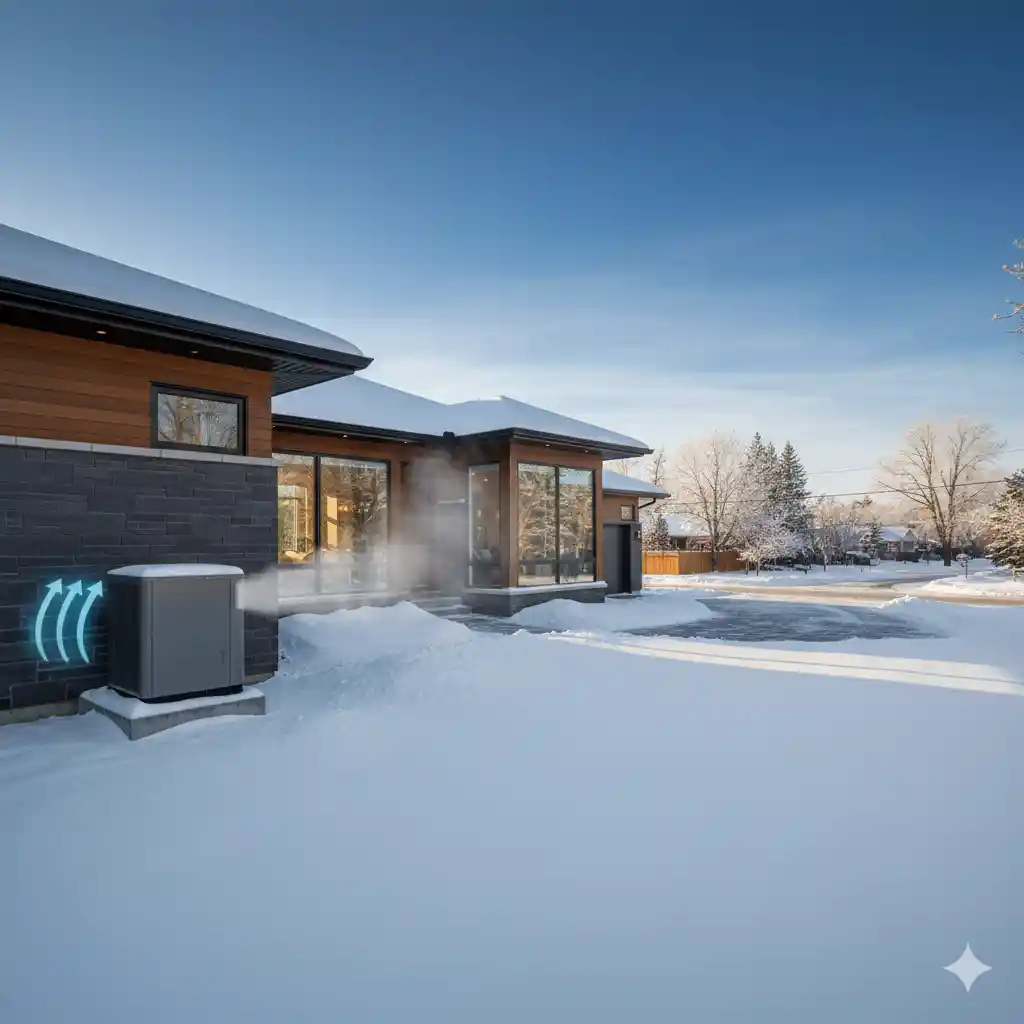
For Ontario homes, heat pumps are sized around 35–45 BTU per square foot of heating capacity — so a 1,500 sq ft home typically needs 52,000–68,000 BTU (roughly 4.5–5.5 tons of nominal capacity), and a 2,000 sq ft home 70,000–90,000 BTU. Insulation, windows, and air sealing decide where in that range your home lands.
That per-square-foot math is the starting point, not the final answer — and heat pumps punish sizing mistakes more than furnaces do. Below is the full BTU chart by home size, the ton-to-BTU conversion, and the cold-climate rules that make Ontario heat pump sizing different from what most American charts assume.
Heat Pump BTU Chart by Home Size
The chart below applies the Ontario heating-climate range (35–45 BTU/sq ft) across common home sizes. The low end fits newer, well-insulated homes; the high end fits older or draftier ones. Nominal tonnage is shown for comparison — one ton equals 12,000 BTU/h.
| Home Size | Heating BTUs Needed (Ontario) | Nominal Tonnage Equivalent |
|---|---|---|
| 800 sq ft | 28,000 – 36,000 BTU | 2.5 – 3 tons |
| 1,000 sq ft | 35,000 – 45,000 BTU | 3 – 4 tons |
| 1,200 sq ft | 42,000 – 54,000 BTU | 3.5 – 4.5 tons |
| 1,500 sq ft | 52,000 – 68,000 BTU | 4.5 – 5.5 tons |
| 2,000 sq ft | 70,000 – 90,000 BTU | 6 – 7.5 tons |
| 2,500 sq ft | 88,000 – 112,000 BTU | 7.5 – 9 tons |
Two things jump out of that table for anyone comparing it to an air conditioner chart: the numbers are bigger, and they climb faster. That’s because in Ontario the heating load — not cooling — is the number a heat pump must meet, and heating a home through a Canadian January takes far more capacity than cooling it through July.
How Many BTUs Per Square Foot Does a Heat Pump Need?
In Ontario’s climate, plan on 35–45 BTU of heating capacity per square foot. Well-insulated post-2010 construction sits near 35; typical 1970s–90s housing stock around 40; and older, leakier homes — Hamilton’s century housing included — push toward 45 or beyond.
Those numbers are meaningfully higher than the 20–30 BTU/sq ft figures on most sizing charts online, and the difference isn’t an error — it’s geography. Most published charts are American and cooling-oriented. Size an Ontario heat pump from one of those and you get a machine that cools beautifully in July and runs out of heat in January.
Tons vs BTUs: The Conversion That Confuses Everyone
One ton of heat pump capacity equals 12,000 BTU per hour — so a 3-ton unit is 36,000 BTU, and a 90,000 BTU requirement translates to 7.5 tons. Quotes and spec sheets switch between the two units freely, which is where most confusion starts.
The catch: a heat pump’s nominal tonnage is its cooling rating at standard test conditions. Its heating output at -15°C is a different, smaller number that depends on the model’s cold-climate engineering. Two “3-ton” heat pumps can differ enormously in how much heat they actually deliver mid-January — which is why the spec that matters for Ontario is the rated heating capacity at low temperature, not the tonnage on the badge.
Why Cold-Climate Ratings Change the Sizing Math
Every air-source heat pump loses capacity as the outdoor temperature falls — exactly when your home needs the most heat. Standard units fade sharply below about -10°C; cold-climate models are engineered to keep delivering strong output at -25°C and below. Natural Resources Canada’s heat pump guidance covers this capacity-vs-temperature behaviour in detail.
Practically, that means the chart above tells you the load — but the model choice decides whether the unit meets that load on the coldest nights or hands off to backup heat. Cold-climate lines like Mitsubishi’s Zuba hold their output far deeper into winter, which is why they dominate whole-home installs here; our Mitsubishi heat pump pricing guide covers what that engineering costs.
The Balance Point: Where Backup Heat Takes Over
The balance point is the outdoor temperature where your heat pump’s falling output crosses your home’s rising heat demand — below it, backup heat fills the gap. A well-sized Ontario system puts that point low enough that the heat pump carries the overwhelming majority of the winter.
Sizing and balance point trade off against each other: a larger unit lowers the balance point but costs more and may short-cycle in mild weather; a smaller one leans harder on backup heat. This is the design conversation that per-square-foot charts can’t settle — it needs your home’s actual heat-loss curve, which is what a Manual J calculation produces.
Why Oversizing a Heat Pump Backfires
An oversized heat pump short-cycles in the shoulder seasons — starting, satisfying the thermostat in minutes, and stopping — which wears the compressor, dehumidifies poorly in summer, and wastes the modulation range the equipment was built for. Bigger is not safer; it’s just worse in both directions.
Modern variable-speed heat pumps soften this penalty because they can throttle down — but they can’t throttle to zero, and the cost of buying capacity you never use is real regardless. The full cost picture of getting sizing wrong is laid out in our guide to what oversized HVAC actually costs.
Ceilings, Basements, and Additions: When Square Footage Misleads
Square footage assumes standard 8-foot ceilings and a typical layout — break either assumption and the chart drifts. Cathedral ceilings and two-storey great rooms heat a volume, not a floor area, and push a home’s real load above its square-foot estimate. Finished basements add heated area that the main-floor measurement misses entirely.
Additions cut the other way when they’re insulated to modern code: a 1990s home with a 2020 addition often has two very different heat-loss rates under one roof. The practical rule — count every heated square foot, note anything with tall ceilings or below grade, and treat the result as the question you bring to a heat-loss calculation, not the answer you leave with.
Ducted, Ductless, or Multi-Zone: Same BTUs, Different Delivery
The BTU requirement is a property of your house; how you deliver those BTUs is a design choice. A central ducted heat pump replaces a furnace in the existing ductwork; ductless mini-splits serve rooms head by head; multi-zone systems mix both. The chart above applies to whole-home sizing — single-room mini-splits are sized to that room’s load alone.
Delivery method changes the quote more than capacity does: multiple indoor heads add equipment and labour, while ducted installs depend on duct condition. If you’re weighing the paths, our heat pump vs furnace comparison and are heat pumps worth it in Canada cover the decision from both ends.
What the Chart Can’t Tell You — and Who Should
A BTU chart gets you to the right conversation, not the right system. The measured version — a heat-loss calculation on your actual house, a look at your ductwork or head placement, and matching a model’s low-temperature output to your load — is what turns the range into a number. That process also determines your rebate eligibility, since Ontario’s Home Renovation Savings program requires eligible equipment sized and installed by a qualified contractor.
Dynamic Heating & Cooling sizes every heat pump against measured heat loss and installs cold-climate systems across Hamilton, Stoney Creek, Ancaster, Dundas, Waterdown, Grimsby, Burlington, Brantford, Caledonia and the Niagara Region. Call 289-962-4811 or see our heat pump services in Hamilton to book a sizing assessment.
FAQs
How many BTUs do I need for a 1,500 square foot house in Canada?
For heating in Ontario’s climate, plan on 52,000–68,000 BTU of capacity for a typical 1,500 sq ft home — the low end for newer, well-sealed construction, the high end for older housing. A heat-loss calculation pins down where your home sits in that range.
What size heat pump do I need for 2,000 square feet?
Around 70,000–90,000 BTU of heating capacity for an Ontario home that size — but the model matters as much as the number, because the unit must deliver that output at deep-winter temperatures, not just at its nominal rating. Cold-climate-rated equipment is what closes that gap.
Is 1 ton really 12,000 BTU?
Yes — one ton of capacity equals 12,000 BTU per hour, a unit inherited from the days of melting ice. But tonnage describes cooling at standard conditions; a heat pump’s heating output at -15°C is a separate spec, and it’s the one that matters for a Canadian winter.
Can a heat pump be too big for my house?
Yes, and it costs you twice: more upfront for capacity you don’t need, then short-cycling in mild weather that wears the compressor, hurts summer dehumidification, and defeats the modulation the equipment was designed around. Correct sizing beats “room to spare” in every season.
Do I size a heat pump to my furnace’s BTU rating?
No. Old furnaces were routinely oversized, so copying the furnace’s rating usually copies its mistake — and furnace input BTUs aren’t equivalent to heat pump output anyway. Size from the home’s measured heat loss, not from the equipment being replaced.
Disclaimer: This article is for general information only. Any prices shown are typical Hamilton-area estimates, not quotes — actual costs depend on your home, your system and site conditions. Rebate programs and their amounts change over time; confirm current details with the program provider before making decisions. For exact pricing on your system, call Dynamic Heating & Cooling at 289-962-4811.