
 Proudly Family-Owned
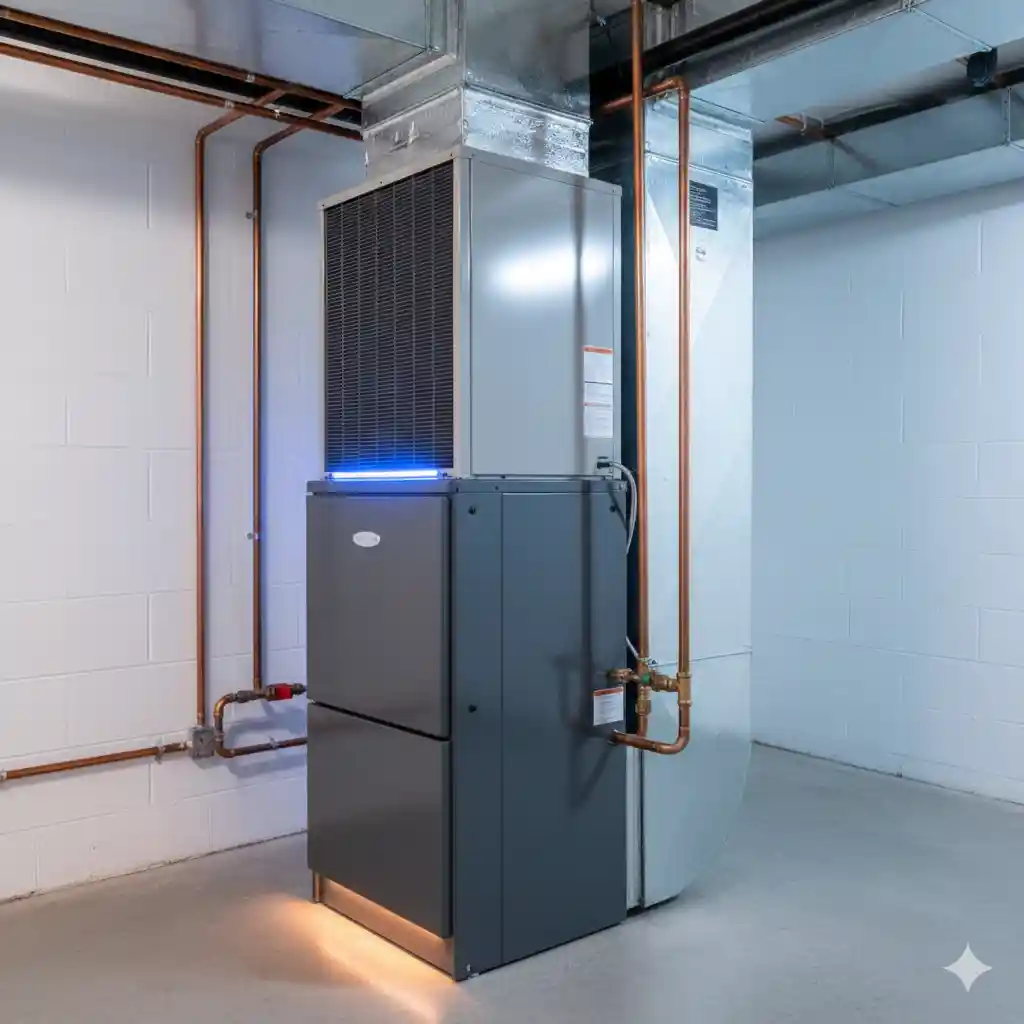
A combo furnace and AC system is a matched set of a high-efficiency gas furnace and a central air conditioner installed together, sharing the same ductwork and air handler. In Ontario, replacing both units simultaneously in 2026 delivers better energy efficiency, lower total installation costs, longer equipment lifespan, and full warranty coverage compared to replacing units separately. For Hamilton homeowners, a matched 96%+ AFUE furnace paired with a 16 SEER2 central AC unit is the recommended configuration for Ontario’s climate — combining reliable winter heating with energy-efficient summer cooling in one coordinated system.
1. Why 2026 Is the Right Year to Upgrade Your HVAC System in Ontario
If your furnace is pushing 15 years and your air conditioner groans every July, 2026 is not the year to keep patching aging equipment — it is the year to make a smart, long-term investment in your home’s comfort infrastructure.
Several forces are converging this year that make upgrading a financially sound decision for Ontario homeowners. Canada’s updated energy efficiency regulations now enforce stricter SEER2 ratings for new air conditioning equipment, meaning newly manufactured units are meaningfully more efficient than anything installed before 2023. Pairing a modern AC with a 96%+ AFUE-rated furnace can reduce your annual heating and cooling costs significantly compared to a system operating at 80% efficiency.
It’s worth being precise about the current rebate landscape, since it’s changed meaningfully in the past year. The federal Canada Greener Homes Grant closed to new applicants in February 2024, and the companion Canada Greener Homes Loan closed to new applications on October 1, 2025 — neither is available for a 2026 upgrade. Ontario’s current active program is the Home Renovation Savings (HRS) Program, delivered by Enbridge Gas and Save on Energy, which offers rebates on qualifying heat pumps, insulation, and other upgrades. Acting in 2026 still makes sense for Hamilton homeowners, but it’s worth confirming what current programs actually cover before assuming a specific federal incentive applies to a standard furnace and AC replacement.
Finally, Hamilton’s housing stock is a practical factor. A large proportion of homes in neighbourhoods across the city — from the East Mountain to Ancaster — were built between 1975 and 2005, putting many original HVAC systems well past their optimal service life. Replacing a system that is already declining in efficiency is not a luxury; for many homeowners, it is overdue.
2. What Is a Combo Furnace & AC System? (And How It Works)
A combo furnace and AC system is not a single appliance — it is two complementary units engineered to work together through your home’s existing ductwork.
2.1 How a Matched System Works
Your gas furnace serves as the heating engine and the air handler — the central hub that moves conditioned air through your ducts. Your central air conditioner’s outdoor unit cools refrigerant, which connects to an evaporator coil mounted directly on top of or inside your furnace’s air handler. In summer, the furnace fan circulates cool air from the AC through your home. In winter, the furnace burners heat the air that same fan distributes.
When both units are matched — meaning they are engineered by the same manufacturer or certified as compatible — they communicate efficiently, operate at rated capacity, and qualify for full manufacturer warranties.
2.2 Matched Combo System vs. Replacing Units Separately — Why the Math Favours Doing Both at Once
Many Hamilton homeowners replace only the failing unit — typically the furnace in winter or the AC in summer — without addressing the aging partner system. This approach creates three compounding problems.

A new high-efficiency AC connected to an old furnace with a weak blower motor will never achieve its rated SEER2 efficiency. The system performs at the level of its least efficient component, regardless of what the new unit is rated for. Most manufacturers also void or significantly reduce warranty coverage when their equipment is paired with unverified third-party units. And replacing both systems in separate service calls means paying for two mobilisations, two sets of permits, and two rounds of labour — a meaningfully higher total cost than a coordinated dual-installation.
2.3 Matched Combo System vs. Mismatched Separate Units — Full Comparison
Efficiency Rating Achieved
- Matched combo system: full rated SEER2 and AFUE as designed
- Mismatched separate units: reduced — capped by the performance of the weaker unit
Manufacturer Warranty
- Matched combo system: full coverage up to 10 years
- Mismatched separate units: partial coverage or voided entirely on the new unit
Installation Cost
- Matched combo system: one mobilisation, shared labour across both units
- Mismatched separate units: two separate service calls, higher total cost
System Lifespan
- Matched combo system: synchronised end-of-life — both units replaced together on a predictable schedule
- Mismatched separate units: staggered failures and ongoing replacement costs with no predictable endpoint
Rebate Eligibility
- Matched combo system: standard furnace and AC replacement is not currently a listed HRS rebate category — if a heat pump is part of your upgrade instead of a standard AC, that portion may qualify for up to $12,000
- Mismatched separate units: same eligibility rules apply regardless of whether units are matched — rebate eligibility depends on equipment type, not on installation timing
3. How Much Does a Combo Furnace and AC System Cost in Hamilton? — 2026 Ontario Pricing
Cost transparency is one of the most searched-for topics in the HVAC industry — and one of the most consistently avoided. Here is a straightforward breakdown for Hamilton and the surrounding Ontario market.
3.1 Furnace Cost Breakdown — Ontario 2026
Installed cost varies primarily by efficiency rating and home size.
Entry-Level — 80% AFUE
- Estimated installed cost (CAD): $2,800 – $3,800
- Note: below the current 95% AFUE federal minimum for new furnace installations — reference only for comparing against an existing older unit
Mid-Range — 96% AFUE
- Estimated installed cost (CAD): $3,800 – $5,200
Premium — 98%+ AFUE, two-stage or variable speed
- Estimated installed cost (CAD): $5,200 – $7,500+
For most Hamilton homeowners, the 96% AFUE mid-range tier represents the strongest return on investment, delivering meaningful annual gas bill savings compared to an older, lower-efficiency unit.
3.2 AC Unit Cost Breakdown — Ontario 2026
Central air conditioner pricing is driven by SEER2 rating and home size, measured in tons of cooling capacity.
Standard — 13.4 SEER2 (minimum 2026 Ontario code)
- Estimated installed cost (CAD): $2,500 – $3,500
Mid-Efficiency — 16 SEER2
- Estimated installed cost (CAD): $3,500 – $5,000
High-Efficiency — 18–21 SEER2
- Estimated installed cost (CAD): $5,000 – $7,000+
The 16 SEER2 tier is the recommended sweet spot for Hamilton’s climate — delivering premium cooling efficiency without the price premium of ultra-high-efficiency systems that are better suited to year-round warm climates than Ontario’s mixed heating and cooling seasons.
3.3 Combined Installation Savings
When both units are replaced together, homeowners in the Hamilton market typically save $800 to $1,500 in combined labour and permitting costs compared to two separate installations. If a heat pump is included as part of the upgrade rather than a standard AC, the current HRS rebate (up to $12,000) can further reduce net cost for that portion of the project — worth discussing with your contractor if you’re weighing a heat pump against a standard AC as part of the combo replacement.
Total estimated range for a matched combo furnace + AC installation in Hamilton, ON (2026): $6,500 – $14,000 installed, before any applicable rebates.
📞 Get a free, no-obligation quote tailored to your home’s size and current system. Call Dynamic Heating & Cooling at 289-962-4811 today — Hamilton’s trusted HVAC experts with 800+ five-star Google reviews.
4. Ontario Rebates & Incentives for HVAC Upgrades in 2026
The financial case for upgrading in 2026 is strengthened by available rebate programs — though it’s important to work from accurate, current information, since a lot of what’s circulating online references programs that have since closed. A licensed HVAC contractor can help Hamilton homeowners navigate what actually applies to their specific upgrade.
4.1 Canada Greener Homes — Current Status
The federal Canada Greener Homes Grant closed to new applicants in February 2024, and the Canada Greener Homes Loan — which previously offered up to $40,000 interest-free — closed to new applications on October 1, 2025. Neither program is available for a 2026 HVAC upgrade. One narrower federal program, the Canada Greener Homes Affordability Program, remains active specifically for low-to-median income homeowners and offers no-cost home retrofits rather than a loan or cash grant — worth checking if your household may qualify.
4.2 Ontario’s Current Rebate Program — Home Renovation Savings (HRS)
Ontario’s active rebate program in 2026 is the Home Renovation Savings (HRS) Program, delivered by Enbridge Gas and Save on Energy with support from the Ontario Government. HRS’s published rebate categories are built around heat pumps (up to $12,000), insulation, windows and doors, smart thermostats, and solar — a standard high-efficiency gas furnace or central AC replacement is not currently a listed HRS rebate category on its own. If a heat pump is a genuine option for your home instead of a standard AC, it’s worth a look, since it’s the piece of a combo upgrade that actually carries direct rebate value in 2026.
4.3 How Dynamic Heating & Cooling Helps You Understand What Applies
Navigating which programs actually apply to a specific project is one of the most common sources of confusion for Hamilton homeowners. The team at Dynamic Heating & Cooling stays current on active federal and provincial programs and will confirm exactly what your specific combo upgrade does and doesn’t qualify for before you commit to equipment — no guesswork, no outdated assumptions.
5. Choosing the Right Combo System for Your Hamilton Home
Not every furnace and AC combination is the right fit for every home. Proper system selection is a technical process — and getting it wrong is expensive.
5.1 Sizing: Why It’s Not Guesswork (Manual J Load Calculation)
The single most common HVAC installation mistake in Ontario is improper system sizing. An oversized furnace will short-cycle — turning on and off rapidly — which increases wear, reduces efficiency, and creates uncomfortable temperature swings. An undersized system will run continuously on the coldest Hamilton nights without reaching your set temperature.
Correct sizing requires a Manual J load calculation — a formal engineering assessment that accounts for your home’s square footage, insulation levels, window placement, ceiling height, and local climate data. Every Dynamic Heating & Cooling installation begins with this assessment, ensuring your system is sized precisely for your specific home.
5.2 Top System Configurations for Ontario Winters
For Hamilton’s climate — with average winter lows approaching -15°C to -20°C on extreme days — the recommended combo configuration is:
- Furnace: 96%+ AFUE, two-stage gas furnace (natural gas)
- Air Conditioner: 16 SEER2, single or two-stage central AC
- Thermostat: Smart thermostat with scheduling and remote access
This configuration delivers year-round comfort and is backed by full manufacturer warranty coverage when installed as a matched pair.
5.3 What to Look for in a Hamilton HVAC Contractor — and How Dynamic Heating & Cooling Measures Up
Choosing the right contractor matters as much as choosing the right equipment. Before committing to any HVAC installation in Hamilton, verify that the contractor meets every item on this checklist. For any project that does include rebate-eligible equipment like a heat pump, licensed contractor installation is a non-negotiable condition of eligibility — meaning the wrong contractor does not just risk a poor installation, it can disqualify you from incentives entirely.

System Sizing Method
- What to look for: Manual J load calculation — the only industry-standard method for correctly sizing HVAC equipment to your specific home
- Dynamic Heating & Cooling standard: Manual J calculation included with every installation
Furnace Efficiency
- What to look for: 96% AFUE or higher — the recommended tier above the federal 95% minimum for meaningful long-term savings
- Dynamic Heating & Cooling standard: Full efficiency range available across all major brands
AC Efficiency
- What to look for: 16 SEER2 or higher — the recommended minimum for Hamilton’s climate
- Dynamic Heating & Cooling standard: Full efficiency range available
Warranty Coverage
- What to look for: 10-year parts and labour minimum — anything less transfers significant risk back to the homeowner
- Dynamic Heating & Cooling standard: 10-year parts and labour guarantee on all installations
Contractor Licensing
- What to look for: Active TSSA certification and full liability insurance — verify both before signing anything
- Dynamic Heating & Cooling standard: Fully licensed and insured on every job
Rebate Navigation
- What to look for: A contractor who gives you an accurate, current picture of what actually qualifies — not one who repeats outdated program names
- Dynamic Heating & Cooling standard: Current program guidance provided, paperwork handled on your behalf for any eligible equipment
Emergency Service
- What to look for: Genuine 24/7 availability — not an answering service or next-business-day callback
- Dynamic Heating & Cooling standard: Around-the-clock emergency service, every day of the year
6. Heat Pump vs. Combo Furnace & AC: Which Is Right for Hamilton in 2026?
The heat pump conversation is unavoidable in 2026 — and for good reason. But for Hamilton specifically, the answer requires honest, climate-aware analysis rather than marketing-driven enthusiasm.
6.1 When a Heat Pump Makes Sense
A heat pump is an excellent primary heating and cooling solution for homeowners who prioritize electrification, are located in areas with milder winter temperatures, or want to take advantage of the current HRS rebate (up to $12,000) to offset the higher upfront cost. Heat pumps are also well-suited for homes without existing natural gas connections or for homeowners planning a full transition away from fossil fuels over the next decade.
6.2 When a Combo Furnace + AC Wins
Hamilton’s winters are genuinely cold. On nights when temperatures fall below -15°C — which happens regularly from December through February — standard air-source heat pumps lose significant heating capacity and efficiency. For homes already connected to natural gas infrastructure, a high-efficiency gas furnace delivers reliable, cost-effective heat output that no current standard heat pump can match at those temperatures without a backup system.
For established Hamilton homeowners with existing ductwork, a gas furnace already in place, and a budget-conscious approach to the upgrade, the combo furnace + central AC remains the most practical, reliable, and cost-effective choice in 2026.
6.3 The Hybrid Solution
For homeowners who want the best of both technologies, a hybrid dual-fuel system — pairing an air-source heat pump with a gas furnace backup — offers maximum efficiency across all seasons. The heat pump handles heating and cooling during mild shoulder seasons (spring and fall), while the gas furnace takes over during Hamilton’s harshest winter conditions. This configuration also captures the HRS rebate on the heat pump portion of the installation.
📞 Not sure whether a heat pump, combo system, or hybrid setup is right for your Hamilton home? Our licensed HVAC technicians will assess your home at no cost. Call 289-962-4811 or visit us at 1527 Upper Ottawa St Unit 13, Hamilton, ON L8W 3J4.