
 Proudly Family-Owned
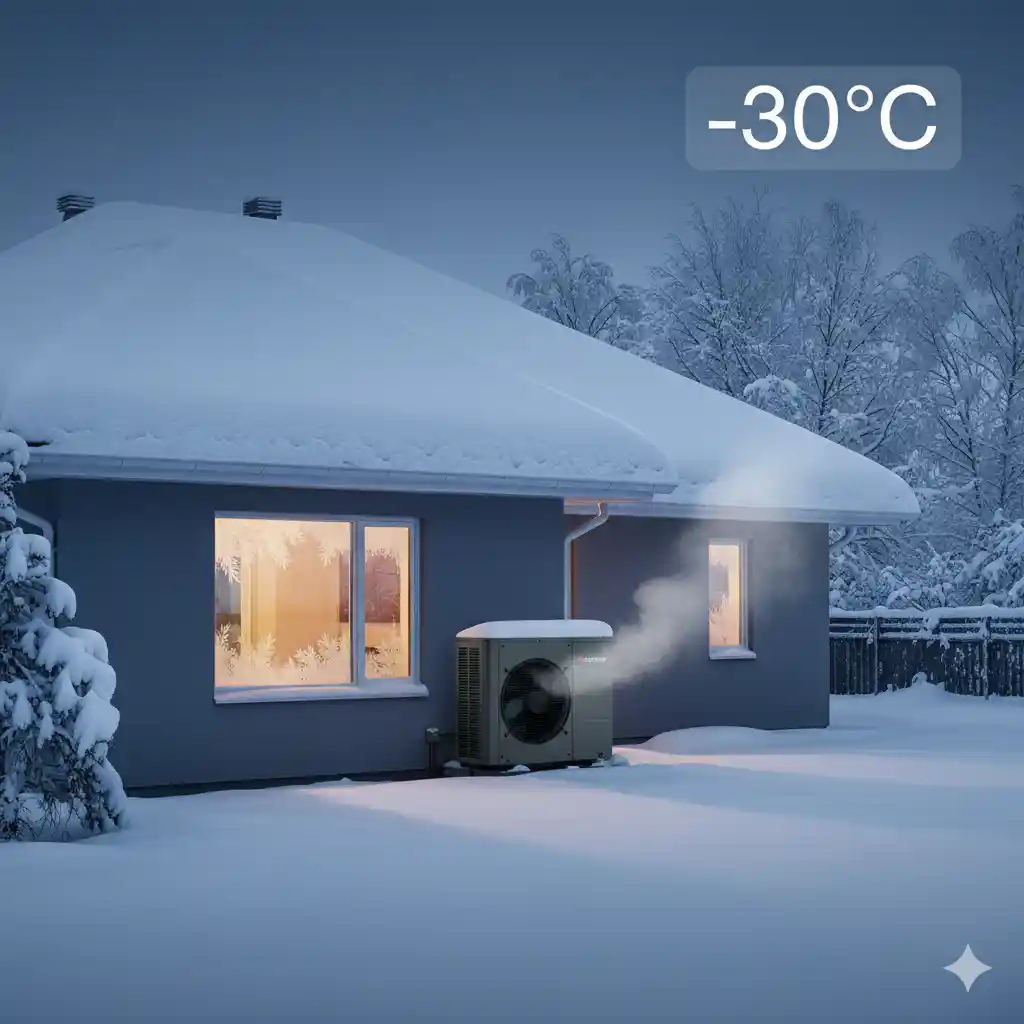
Do Cold-Climate Heat Pumps Actually Work in Hamilton Winters? The 2026 Answer Is Yes. Modern cold-climate heat pumps work at -30°C. Leading 2026 models from Mitsubishi, Daikin, and Bosch maintain rated heating capacity down to -25°C and continue operating beyond that threshold. For Hamilton — where winters average -10°C to -15°C with occasional extreme cold snaps — a properly sized cold-climate heat pump, or a hybrid CCHP and furnace system, delivers reliable, efficient, year-round heating.
The key is choosing the right technology for Hamilton’s specific Climate Zone 5–6 conditions and working with a licensed local installer who understands your home, not just the spec sheet.
Cold-Climate Heat Pump Performance by Temperature — Hamilton Reference Guide
0°C to -10°C — Full Rated Capacity | COP 2.5 to 3.5 The heat pump runs alone at peak efficiency. This temperature range covers the majority of Hamilton’s heating season from October through April.
-10°C to -20°C — High Efficiency Maintained | COP 1.8 to 2.5 The heat pump continues running alone. Efficiency moderates but remains strong — this range covers Hamilton’s typical January and February overnight lows.
-20°C to -25°C — Moderate Efficiency | COP 1.4 to 1.8 The heat pump runs independently with hybrid backup on standby. Hamilton experiences temperatures in this range on approximately 8 to 12 days per year.
-25°C to -30°C — Reduced but Operational | COP 1.0 to 1.4 The heat pump continues operating with hybrid backup activating as needed. This range represents a statistical outlier in Hamilton — typically 3 to 7 days per year, concentrated in January and February.
Below -30°C — Furnace Backup Takes Over | COP below 1.0 At this threshold, the gas furnace in a dual-fuel configuration carries the primary heating load while the heat pump stands by, resuming full operation once temperatures rise.
Why the “Heat Pumps Don’t Work in Canadian Winters” Myth Still Exists — And Why It’s Outdated
If someone told you heat pumps don’t work in Hamilton winters, they weren’t necessarily wrong — they were working with outdated information. The technology has changed fundamentally, and the difference between a conventional heat pump from 2012 and a 2026 cold-climate model is not an incremental upgrade. It is a complete engineering leap.
Conventional heat pumps installed across Ontario throughout the 2000s and early 2010s used single-speed compressors that struggled to extract usable heat from outdoor air once temperatures dropped below -5°C to -8°C. At that point, the system fell back on electric resistance heat strips — an expensive, inefficient backup that sent electricity bills surging. Hamilton homeowners who experienced this firsthand understandably wrote off heat pumps entirely. That reputation, though now thoroughly outdated, still lingers.
What Makes a 2026 Cold-Climate Heat Pump Fundamentally Different
The defining technology behind 2026 cold-climate models is the variable-speed inverter compressor, combined with Enhanced Vapor Injection (EVI) technology. Instead of cycling on and off at a fixed speed, these compressors continuously modulate their output — slowing down when less heat is needed, ramping up aggressively when temperatures plunge. EVI pre-heats the refrigerant mid-cycle, allowing the system to extract meaningful heat energy from air as cold as -30°C.
Compressor Type
- Conventional heat pump: single-speed
- 2026 cold-climate heat pump: variable-speed inverter
Rated Low Temperature
- Conventional heat pump: -5°C to -8°C
- 2026 cold-climate heat pump: -25°C to -30°C
Core Technology
- Conventional heat pump: standard refrigerant cycle
- 2026 cold-climate heat pump: Enhanced Vapor Injection (EVI)
Backup Heat Source
- Conventional heat pump: electric resistance strips — expensive and inefficient
- 2026 cold-climate heat pump: furnace or minimal strip heat
COP at -15°C
- Conventional heat pump: 0.8 to 1.2 — near breakeven with electric resistance
- 2026 cold-climate heat pump: 1.8 to 2.5 — still meaningfully efficient
2026 Rebate Eligibility
- Conventional heat pump: not eligible
- 2026 cold-climate heat pump: eligible under Ontario’s Home Renovation Savings (HRS) Program
Hamilton’s Actual Winter Temperatures — The Data That Makes the Case
Before evaluating any heating system, accurate local data matters more than national averages or worst-case scenarios borrowed from Sudbury or Thunder Bay. Hamilton’s climate is meaningfully different — and that difference works in your favour.
Hamilton sits in Climate Zone 5–6, among the more temperate regions of inland Ontario. The city benefits from the moderating influence of Lake Ontario, which buffers temperature extremes — particularly in the lower city and Hamilton Harbour area. Average January lows sit between -10°C and -13°C. Extreme cold snaps pushing -25°C to -30°C occur but are statistical outliers — typically lasting 3 to 7 days per year, concentrated in January and February. Newer subdivisions in Ancaster, Waterdown, and Dundas sit slightly further from the lake’s influence but remain firmly within efficient cold-climate heat pump operating range for the overwhelming majority of the heating season.
The Balance Point — When Does a Heat Pump Need Backup in Hamilton?
The balance point is the outdoor temperature at which a heat pump’s heating output exactly matches your home’s heat loss — the threshold where backup heat begins to assist. For a properly sized 2026 cold-climate heat pump in a well-insulated Hamilton home, that balance point typically sits between -20°C and -25°C.
Given that Hamilton temperatures drop below -20°C on average only 8 to 12 days per year, a correctly specified cold-climate heat pump handles the full Hamilton heating season with either no backup activation or minimal backup use. The math strongly favours cold-climate heat pump technology for this city.

CCHP performance zones across Hamilton’s winter temperatures, showing peak or moderate efficiency for 97% of winter days.
Hamilton Monthly Temperature vs. CCHP Performance Zone
October — Average Low +2°C | Peak Efficiency Zone | Backup Heat: No
November — Average Low -4°C | Peak Efficiency Zone | Backup Heat: No
December — Average Low -9°C | Peak Efficiency Zone | Backup Heat: No
January — Average Low -13°C | Peak Efficiency Zone | Backup Heat: Rarely
February — Average Low -12°C | Peak Efficiency Zone | Backup Heat: Rarely
March — Average Low -6°C | Peak Efficiency Zone | Backup Heat: No
April — Average Low +1°C | Peak Efficiency Zone | Backup Heat: No
Every month of Hamilton’s heating season falls within the peak efficiency operating zone for a properly specified 2026 cold-climate heat pump. Backup heat activation is a rare event in this city — not a routine one. Contact Dynamic Heating & Cooling to discuss which cold-climate model and configuration is the right fit for your Hamilton home’s specific heating load and insulation profile.
📞 Not sure if your Hamilton home is suited for a cold-climate heat pump? Our licensed technicians provide free home assessments — no pressure, just straight answers from people who know Hamilton winters firsthand. Call Dynamic Heating & Cooling at 289-962-4811 or visit dynamicheatandcool.ca.
Top Cold-Climate Heat Pump Models for Hamilton Homes — 2026 Comparison
Not all cold-climate heat pumps are built equally for Hamilton’s Climate Zone 5–6 conditions. Three models stand out in 2026 for Hamilton installations — each with a distinct profile that suits different home types, lot configurations, and efficiency priorities.
Mitsubishi Zuba-Central
- Rated capacity to: -30°C
- COP at -15°C: ~2.0
- COP at -25°C: ~1.4
- Discharge direction: Vertical
- Best for: Most Hamilton homes — the broadest fit across the market
- Estimated installed cost (Hamilton, pre-rebate): $12,000 – $18,000
- Warranty: 12 years (registered)
Daikin FIT
- Rated capacity to: -30°C
- COP at -15°C: ~1.9
- COP at -25°C: ~1.3
- Discharge direction: Side (horizontal)
- Best for: Tight lots and older Hamilton neighbourhoods where vertical discharge clearance is limited
- Estimated installed cost (Hamilton, pre-rebate): $11,000 – $16,000
- Warranty: 12 years (registered)
Bosch IDS 2.0
- Rated capacity to: -22°C for full capacity — operational to -30°C with modest efficiency reduction
- COP at -15°C: ~2.1 — the highest of the three at this temperature
- COP at -25°C: ~1.2
- Discharge direction: Vertical
- Best for: High-efficiency builds — particularly well-insulated newer construction in Ancaster and Waterdown
- Estimated installed cost (Hamilton, pre-rebate): $10,000 – $15,000
- Warranty: 10 years
The Bosch IDS 2.0 leads on HSPF2 efficiency ratings and delivers the lowest cost-per-BTU heating available in 2026 for homes with strong insulation. The Mitsubishi Zuba-Central and Daikin FIT both maintain full rated capacity to -30°C, making them the stronger choice for older Hamilton homes or properties with higher heat loss profiles.
Hybrid Heat Pump Systems — The Smart Path for Hamilton Homeowners With a Newer Furnace
For Hamilton homeowners with a gas furnace that still has years of useful life remaining, a hybrid heat pump system is often the most practical and cost-effective path to efficient heating — without the cost of replacing equipment that does not yet need replacing.
A hybrid system pairs a cold-climate heat pump with your existing gas furnace. The heat pump handles all heating duties when outdoor temperatures are above the programmed crossover point — typically set between -15°C and -20°C for Hamilton homes. When temperatures drop below that threshold, the furnace seamlessly takes over. The result: heat pump efficiency during 90% or more of Hamilton’s winter when it operates at its best, and gas reliability during extreme cold snaps — without paying to replace a furnace ahead of schedule.

A flow diagram showing how a hybrid system automatically switches from a heat pump to a backup gas furnace when temperatures drop below -15°C
Hybrid vs. Full Cold-Climate Heat Pump — Which Is Right for Your Hamilton Home?
Existing furnace age
- Choose full CCHP: furnace is 10 or more years old and approaching end of life
- Choose hybrid system: furnace is 5 years old or newer with significant life remaining
Home insulation
- Choose full CCHP: well-insulated post-2000 construction
- Choose hybrid system: older home with some drafts or insulation gaps
Current heating fuel
- Choose full CCHP: currently on electric baseboard heating
- Choose hybrid system: currently on natural gas
Primary priority
- Choose full CCHP: maximum long-term savings
- Choose hybrid system: lowest upfront cost
Hamilton neighbourhood
- Choose full CCHP: Ancaster, Waterdown, newer builds
- Choose hybrid system: lower city, older housing stock
Rebate eligibility
- Choose full CCHP: eligible for HRS Program rebates (up to $5,600)
- Choose hybrid system: also HRS eligible — confirm specifics with your installer
How a Hybrid System Operates Across Hamilton Winter Conditions
Mild Hamilton winter day — -5°C
- System active: heat pump only
- Estimated efficiency: COP 2.5 to 3.0
Average January night — -13°C
- System active: heat pump only
- Estimated efficiency: COP 1.9 to 2.3
Cold snap — -20°C
- System active: heat pump with furnace on standby
- Estimated efficiency: COP 1.5 to 1.8
Extreme cold event — -28°C
- System active: furnace takes over as primary heat source
- Efficiency: gas furnace operating at approximately 95% AFUE
2026 Rebates — How Hamilton Homeowners Can Reduce Installation Cost
The financial case for a cold-climate heat pump in 2026 is strong, but it’s important to work from accurate, current program information — several older programs still referenced online have closed.
Ontario Home Renovation Savings (HRS) Program
- Maximum amount: up to $5,600 for a qualifying heat pump installation
- Eligibility trigger: CCHP installation by a registered contractor
- Application method: Contractor submits on your behalf — Dynamic Heating & Cooling manages this process completely for every customer
- No pre-installation home energy audit required for single heat pump upgrades — a barrier removed in 2025 that significantly simplified the process
Canada Greener Homes Loan — Closed to New Applicants
- Status: The federal Greener Homes Loan, which previously offered up to $40,000 at 0% interest, closed to new applications on October 1, 2025. If you already had an approved loan before that date, it remains valid — but this financing option is no longer available for a new 2026 installation and should not be counted on when budgeting.
Oil-to-Heat Pump Affordability Program (OHPA)
- Eligibility: Income-qualified households currently heating with oil, transitioning to a cold-climate heat pump — not available to all oil-heated homes regardless of income, and not available to propane or wood-heated homes
- Status: The federal direct-application deadline was July 31, 2026, which has now passed. Income-qualified Ontario households may still be able to access support through Save on Energy’s Energy Affordability Program, which co-delivers this funding as a fully installed system at no cost rather than a cash rebate.
- If you heat with oil, confirm your current eligibility and status directly with Save on Energy or a registered contractor before assuming a specific dollar figure applies to your household.
Realistic Savings Potential — Hamilton Homeowners
For most Hamilton homeowners, the primary rebate available for a 2026 cold-climate heat pump installation is the Home Renovation Savings Program, up to $5,600. This is the figure to plan around for a straightforward electric or gas-heated home. Income-qualified oil-heated households may have access to additional support through the Energy Affordability Program, but this depends on individual eligibility and is not a guaranteed stacked amount. Dynamic Heating & Cooling handles the full application process and will confirm your actual eligibility and expected rebate before you commit to a system.
📞 Rebate funding caps historically exhaust by October — don’t leave money on the table. Call Dynamic Heating & Cooling at 289-962-4811 today. We confirm your eligibility, install your system, and submit every rebate application on your behalf — at no extra charge.