
 Proudly Family-Owned
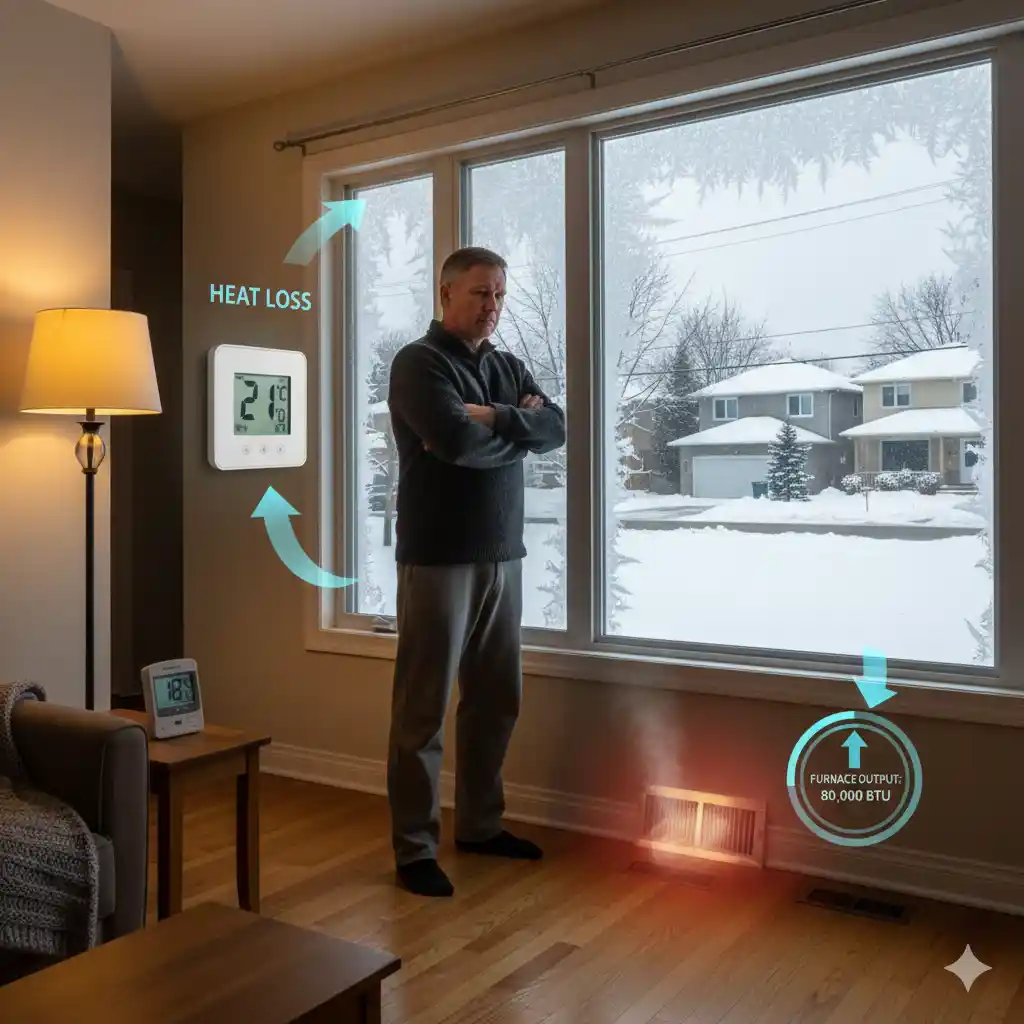
The 5 Warning Signs Your Furnace Is Too Small for Your Hamilton Home
An undersized furnace does not just leave you cold — it drives up gas bills, accelerates mechanical wear, and shortens your system’s lifespan. Here are the five signals that your furnace cannot keep up with your home’s heating load.
Sign #1 — Your Furnace Runs Constantly But the House Never Gets Warm
This is the most telling symptom. A properly sized furnace runs in cycles — it reaches your set temperature, shuts off, and restarts when the temperature drops. An undersized furnace runs nearly continuously during cold weather because it is producing heat at full capacity but cannot satisfy the thermostat’s demand. If your furnace seems to never shut off during a cold Hamilton night, that is not normal — and it is costing you significantly on your gas bill.
Sign #2 — Persistent Cold Spots or Uneven Heating Room to Room
Do your upstairs bedrooms or rooms at the far end of the house never quite reach the temperature of the main living area? Uneven heating is a classic undersizing signal. When a furnace lacks sufficient output, heat dissipates before it reaches every corner of the home — particularly in larger homes, homes with additions, or older Hamilton properties where the ductwork was designed for a different era’s heating equipment.
Sign #3 — Your Heating Bills Keep Climbing With No Explanation
A furnace running at 100% capacity for extended periods consumes significantly more gas than one cycling normally. If your heating bills have climbed year over year without any change in your thermostat habits, undersizing could be the driver. Many Hamilton homeowners assume rising utility rates are the cause, when the real issue is a furnace working twice as hard to deliver half the comfort.
Sign #4 — Your Furnace Short Cycles (Turns On and Off Rapidly)
This one surprises people. Short cycling is more commonly associated with oversized furnaces, but it can also occur in undersized systems when the heat exchanger overheats from continuous strain. If your furnace turns on and off every few minutes without the home warming up, that is a mechanical stress signal warranting immediate assessment. Left unaddressed, short cycling accelerates wear on the heat exchanger, blower motor, and ignition components. For the other common causes, see our guide to furnace short cycling.
Sign #5 — Your Home Takes Hours to Recover After a Cold Night
Setting your thermostat back overnight to save energy is a sensible habit. But if your home takes three, four, or five hours to return to a comfortable temperature the next morning, your furnace lacks the BTU reserve capacity to recover quickly. A right-sized furnace for a Hamilton home should recover 2–3°C within 30–45 minutes under normal cold-weather conditions.

Undersized Furnace Warning Signs — Quick Reference
Furnace Runs Constantly
- What you’ll notice: never shuts off during cold weather
- What it indicates: BTU output is below your home’s heating load demand
Cold Spots in Rooms
- What you’ll notice: far rooms never reach the set temperature
- What it indicates: insufficient heat distribution capacity
Rising Heating Bills
- What you’ll notice: gas costs climbing with no apparent cause
- What it indicates: the system is running at maximum output continuously
Short Cycling
- What you’ll notice: rapid on/off cycling
- What it indicates: heat exchanger overheating under continuous strain
Slow Recovery Time
- What you’ll notice: hours to warm up after a thermostat setback
- What it indicates: no BTU reserve available for rapid temperature recovery
If you recognise two or more of these signs in your own home, the issue is unlikely to resolve on its own — and continuing to run an undersized furnace through a Hamilton winter compounds both the cost and the mechanical wear with every cold night. The root cause is almost always a furnace whose BTU output was never correctly matched to the home’s heating load, which a proper Manual J calculation identifies and corrects. Contact Dynamic Heating & Cooling to book a load assessment and confirm whether your furnace is right-sized for your Hamilton home.
How Furnace Sizing Actually Works — The Manual J Explained
What Is a Manual J Load Calculation?
Manual J is the industry-standard methodology — developed by the Air Conditioning Contractors of America (ACCA) — for calculating the precise heating and cooling load of a specific home. It is the only scientifically accurate method for determining what size furnace your home actually needs. Any HVAC contractor who recommends a furnace size based purely on square footage rules of thumb, or simply matches the size of your old unit, is doing you a disservice.
A proper Manual J calculation produces a number in BTUs per hour — the exact output your home requires to maintain comfort at Hamilton’s winter design temperature.
The Key Inputs: What a Manual J Measures
A licensed HVAC technician performing a Manual J assessment for your Hamilton home will evaluate:
- Conditioned square footage — including basement if heated
- Ceiling height — 8-foot vs. 9-foot vs. vaulted ceilings change the volume of air being heated
- Insulation R-values — walls, attic, basement, and crawlspace
- Window type, size, and orientation — double-pane vs. single-pane, south-facing vs. north-facing
- Air leakage and infiltration rate — how drafty is the home’s envelope?
- Number of occupants — human bodies contribute heat load
- Local climate data — Hamilton’s specific heating degree days and design temperature
Each of these inputs affects the final BTU calculation significantly. Two homes with identical square footage in Hamilton can have heating loads that differ by 30–40% based on insulation, windows, and air sealing alone.
Why BTU-Per-Square-Foot Rules of Thumb Are Dangerously Misleading
You may have seen online calculators suggesting “30–35 BTU per square foot” as a furnace sizing guide. For Hamilton, this is a starting point at best and a liability at worst. A poorly insulated 1970s bungalow on the Hamilton Mountain with single-pane windows and an uninsulated basement may need 45–50 BTU per square foot. A well-sealed, recently renovated home in Ancaster with triple-pane windows and spray foam insulation may need only 20–25 BTU per square foot. The rules of thumb treat every home the same — Manual J treats your home as the specific structure it actually is.
Hamilton-Specific Sizing Factors Most Homeowners Don’t Know About
Hamilton’s Climate Zone and Winter Design Temperature
Hamilton is classified under NRCan’s climate zone system with a heating design temperature of approximately -18°C to -20°C depending on the specific microclimate. Homes on the Hamilton Mountain face different wind exposure than those in lower Hamilton or Dundas. Burlington-area properties have their own lake-effect considerations. These local variables matter in a Manual J calculation and are invisible to any national sizing chart.
Older Hamilton Homes: The Hidden Sizing Trap
A significant portion of Hamilton’s housing stock was built between 1950 and 1990 — an era when insulation standards were far below today’s code, single-pane aluminum windows were standard, and air sealing was essentially non-existent. Many of these homes have had new furnaces installed over the decades by contractors who simply matched the outgoing unit’s size — perpetuating a sizing problem that may have existed since the home was built.
If you live in a post-war bungalow, a 1970s side-split, or a 1980s two-storey in Dundas, Ancaster, or the Hamilton Mountain, there is a meaningful chance your current furnace size was inherited from a previous incorrect sizing decision — not calculated for your home’s actual needs.
How Renovations and Additions Change Your Heating Load
Added a finished basement? Enclosed a garage? Built a rear addition? Every change to your home’s conditioned square footage or envelope changes your heating load — and if your furnace wasn’t resized when those changes were made, you may have been slowly undersizing your system without realizing it.
📋 Hamilton homes vary widely in age, insulation, and layout. The only accurate answer is a proper Manual J load calculation. Book yours today — Dynamic Heating & Cooling, 1527 Upper Ottawa St Unit 13, Hamilton, ON L8W 3J4 — (289) 962-4811.
Undersized vs. Oversized — Why Bigger Isn’t Always Better
It’s tempting to think the solution to an undersized furnace is simply buying the biggest unit available. This is a costly mistake. An oversized furnace heats the space so quickly that it satisfies the thermostat before completing a full heating cycle — a condition called short cycling. Short cycling means the furnace never runs long enough to properly distribute heat, properly humidify the air, or stabilize temperatures throughout the home. It also puts enormous mechanical stress on the system, drastically shortening its lifespan.
The right furnace for your Hamilton home is not the largest — it’s the one whose BTU output precisely matches your home’s calculated heating load, with a modest design buffer for extreme cold events. That’s the Goldilocks principle of furnace sizing, and it’s exactly what a Manual J delivers.
What To Do If You Suspect Your Furnace Is Undersized — A 4-Step Action Plan
Step 1 — Document the Symptoms
Before calling a technician, spend a week tracking key data points: How long does your furnace run per cycle? Does it reach your thermostat’s set temperature? Which rooms are coldest? How do your monthly gas bills compare to previous years? This documentation helps your HVAC technician diagnose faster and more accurately.
Step 2 — Request a Manual J Load Calculation
Ask your HVAC contractor specifically for a Manual J load calculation — not just a visual inspection or a square-footage estimate. A licensed contractor performing a proper Manual J will take measurements, assess your insulation and windows, and deliver a specific BTU recommendation tailored to your home.
Step 3 — Understand Your Replacement Options
If your furnace is confirmed undersized, modern Hamilton replacement options include single-stage, two-stage, and variable-speed modulating furnaces. Two-stage and variable-speed models are significantly more efficient in Hamilton’s climate because they run at lower capacity during mild winter days and ramp up during extreme cold — matching output to demand rather than running full-blast continuously.
Step 4 — Ask About Home Renovation Savings Program Eligibility
Upgrading to a high-efficiency furnace at 96% AFUE or higher, or to a heat pump system, may qualify your Hamilton home for rebates under Ontario’s Home Renovation Savings Program — currently offering up to $5,600 for qualifying heat pump installations. A licensed contractor can help you understand current eligibility requirements and connect your upgrade to available incentives — meaningfully reducing your out-of-pocket replacement cost.

The 6 Manual J Inputs That Determine Correct Furnace Sizing for Hamilton Homes
A proper Manual J calculation is not a square-footage guess. It accounts for six specific factors that determine your home’s true heating load.
Conditioned Square Footage
Establishes the baseline volume of air requiring heating.
Ceiling Height
Higher ceilings mean greater air volume, which directly increases BTU requirements — a factor square-footage-only estimates miss entirely.
Insulation R-Value
Older Hamilton homes are frequently and significantly under-insulated, dramatically affecting true heat loss.
Window Type and Orientation
Single-pane windows remain common in pre-1990 Hamilton housing stock and are a major source of heat loss.
Air Leakage and Infiltration
Drafty older Hamilton homes lose heat rapidly in -20°C conditions — infiltration rates substantially change the heating load.
Local Climate Design Temperature
Hamilton’s -20°C design temperature requires accurate local data, not national averages borrowed from warmer or colder regions.
How Much Does a Right-Sized Furnace Cost in Hamilton, ON?
Furnace replacement costs vary based on efficiency tier, brand, and installation complexity.
Entry-Level Single-Stage — 80% AFUE
Estimated installed cost (Hamilton, ON): $2,800 – $3,800
Mid-Efficiency Two-Stage — 92–95% AFUE
Estimated installed cost (Hamilton, ON): $3,800 – $5,200
High-Efficiency Variable Speed — 96–98% AFUE
Estimated installed cost (Hamilton, ON): $5,200 – $7,500+
Costs vary based on home complexity, existing ductwork condition, and permit requirements.
Home Renovation Savings Program and Current Incentives
Upgrading to a qualifying high-efficiency furnace or heat pump may make your Hamilton home eligible for rebates through Ontario’s Home Renovation Savings Program — delivered through Enbridge Gas and Save on Energy, with support from the Ontario Government. Current published incentives include up to $5,600 for qualifying heat pumps and up to $7,700 for insulation upgrades, though amounts and eligibility can change. Your Dynamic Heating & Cooling technician can assess your current system, confirm what upgrades qualify, and help you navigate the application process — so you’re not leaving money on the table.
Local Resources & Citations
1. Natural Resources Canada (NRCan) — Heating Equipment for Residential Use. Canada’s federal energy authority confirms that space heating accounts for 63.6% of energy used in the average Canadian home. Visit this page to use the official ENERGY STAR Product Finder to verify that any replacement furnace your contractor recommends meets federally regulated minimum efficiency standards before you buy.
2. Home Renovation Savings Program Hamilton homeowners who upgrade to a qualifying high-efficiency furnace or heat pump may be eligible for rebates through this Enbridge Gas and Save on Energy partnership, launched with support from the Ontario Government, to help Ontarians improve home energy efficiency and comfort — check this page first to see what incentives your specific upgrade qualifies for before signing any replacement contract.
3. Technical Standards and Safety Authority (TSSA) — Find a Registered Fuels Contractor Ontario’s public safety regulator for all gas work — in Ontario, all contractors working on fuel-burning equipment must be registered with TSSA and renew their registrations annually to continue operating legally — use this official lookup tool to verify that any HVAC technician working on your Hamilton furnace holds a valid, active registration before allowing work to begin.
4. City of Hamilton — Building Permit & Renovation Requirements Hamilton’s official Building Division portal — while a standard furnace-for-furnace replacement does not require a permit, projects that add or relocate gas lines or ductwork require permit applications that must include heat loss and heat gain calculations and mechanical ventilation and heating design — check here to confirm what your specific project triggers before your contractor begins.
Financing Options for Hamilton Homeowners
Dynamic Heating & Cooling offers financing options designed for Hamilton homeowners who need a right-sized system now without the full upfront cost. Ask about current financing plans when you book your assessment.
🏠 Ready to stop guessing and get a furnace that’s right for your Hamilton home? Dynamic Heating & Cooling serves Hamilton, Ancaster, Dundas, Burlington, and surrounding areas. Call (289) 962-4811 or visit dynamicheatandcool.ca — our licensed technicians are available 24/7, including emergency furnace service.