
 Proudly Family-Owned
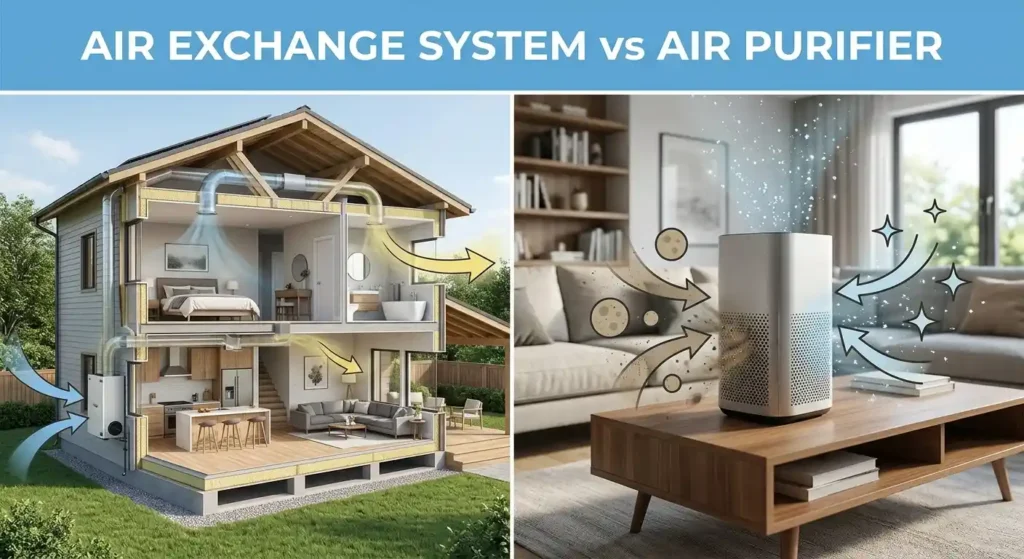
Bottom Line Up Front: The choice between an air exchange system and an air purifier depends on your primary goal. Need fresh outdoor air and whole-home ventilation? Choose an air exchange system. Want to clean existing indoor air of allergens and particles? An air purifier is your best bet. Many homes benefit from both working together.
Indoor air quality has become a critical concern for homeowners, especially as homes are built tighter and more energy-efficient. With Americans spending roughly 90% of their time indoors, understanding the difference between air exchange systems and air purifiers could significantly impact your family’s health and comfort.
Understanding Air Exchange Systems: Your Home’s Breathing System
An air exchange system — also called an air-to-air exchanger or air-to-air heat exchanger — acts as your home’s mechanical lungs, continuously replacing stale indoor air with fresh outdoor air. These whole-house ventilation systems address a fundamental problem in modern construction: homes are so well-sealed for energy efficiency that natural air circulation is virtually non-existent.
How Air Exchange Systems Work
Air exchangers use a central air exchange unit with a system of ducts to remove stale indoor air and replace it with fresh outdoor air throughout your entire home. When you activate the system in one room, it begins circulating air to every connected area of your house.
Key Features:
- Whole-house coverage through integrated ductwork
- Continuous ventilation that operates 24/7 if needed
- Humidity control by exchanging moisture-laden indoor air
- Energy recovery through heat exchange technology (HRV/ERV systems)
Types of Air Exchange Systems
Heat Recovery Ventilators (HRVs): Transfer thermal energy between outgoing and incoming air streams, with sensible heat recovery averaging about 70%. Best suited for cold climates.
Energy Recovery Ventilators (ERVs): Exchange both heat and moisture, with latent recovery usually between 40-60%, helping maintain ideal relative humidity of 40-50%. Ideal for hot, humid climates.
Balanced Ventilation Systems: Use fans to both draw air into your home and push air out, balancing air intake and output for all climates.
Air Purifiers: Targeted Air Cleaning Solutions
Air purifiers focus on cleaning and filtering the existing air in your home rather than replacing it. These typically portable units excel at removing specific contaminants from indoor air.
How Air Purifiers Function
Air purifiers draw in air pollutants, trap them with filters, and disseminate clean air back into your space. Unlike air exchange systems, they recycle the same indoor air without introducing fresh outdoor air.
Core Technologies:
- HEPA Filters: Certified to remove at least 99.97% of dust, pollen, mold, bacteria, and airborne particles with a size of 0.3 microns (EPA standard)
- Activated Carbon Filters: Target odors, volatile organic compounds (VOCs), and gaseous pollutants
- UV-C Light: Kills germs, viruses, and bacteria
- Pre-filters: Capture larger particles like pet hair and dust
Proven Effectiveness
Recent studies confirm air purifiers deliver measurable results:
- Particulate matter reduction: HEPA air purifiers reduced PM levels by 12-52% in general indoor air and 29-53% when external pollution sources are present
- Real-world performance: Studies show portable air cleaners achieve 78.8% reduction in PM2.5 concentrations in primary rooms and 57.9% in secondary rooms
- Optimal conditions: Under best settings (three machines with medium-flow), HEPA air cleaners can achieve indoor PM2.5 improvements of up to 56%
- Health benefits: Studies confirm HEPA air purifiers benefit allergy and asthma symptoms, as well as cardiovascular health
Air Exchange Systems vs. Air Purifiers — Key Differences for Hamilton Homeowners
These two technologies are frequently confused but serve fundamentally different functions. Understanding what each does — and what it cannot do — is the starting point for any indoor air quality decision.
Primary Function
- Air exchange system: replaces stale indoor air with fresh outdoor air — addresses the source of indoor air quality problems
- Air purifier: cleans and recycles existing indoor air — treats air already in the home without introducing fresh outdoor air
Coverage
- Air exchange system: whole house — integrated into your HVAC system and ductwork
- Air purifier: single room or specific area — coverage is limited to the space surrounding the unit
Installation
- Air exchange system: professional installation with ductwork connection required
- Air purifier: plug-and-play portable units — no professional installation needed
Fresh Air Introduction
- Air exchange system: yes — actively brings outdoor air into the home
- Air purifier: no — recirculates and filters the same indoor air volume
Particle Removal
- Air exchange system: basic filtration of incoming outdoor air
- Air purifier: advanced multi-stage filtration — superior particle capture for allergens, dust, and airborne contaminants already present indoors
Humidity Control
- Air exchange system: yes — manages indoor moisture levels as part of the ventilation process
- Air purifier: no humidity management capability
Energy Efficiency
- Air exchange system: heat and energy recovery options available — ERV and HRV configurations recover thermal energy from outgoing air to pre-condition incoming fresh air
- Air purifier: continuous power consumption with no energy recovery
Lifespan
- Air exchange system: 15 – 25 years with proper maintenance
- Air purifier: 2 – 7 years depending on technology and filter replacement frequency
Cost Range
- Air exchange system: $2,500 – $4,200 including professional installation
- Air purifier: $80 – $1,200
Which System Do You Actually Need?
Choose an Air Exchange System If:
✅ Your home feels stuffy or has poor air circulation
- Modern, tightly-sealed homes often trap stale air
✅ You’re dealing with humidity issues
- Air exchangers help balance indoor humidity levels, creating a more comfortable and healthier living environment
✅ You want whole-house air quality improvement
- Air exchangers are typically used to ventilate an entire house and can contribute to energy efficiency through heat recovery
✅ High CO2 levels are a concern
- Essential for homes with limited natural ventilation
✅ You’re building or renovating
- Perfect time to install ductwork and integrate with HVAC systems
Choose an Air Purifier If:
✅ You have specific allergies or asthma
- HEPA air purifiers have been shown to benefit allergy and asthma symptoms, as well as cardiovascular health
✅ You need targeted particle removal
- Excellent for pet dander, pollen, dust, and smoke
✅ You’re renting or want flexibility
- No installation required, easily moved between rooms
✅ You have a limited budget
- Much lower upfront costs than whole-house systems
✅ Outdoor air quality is poor
- When wildfire smoke or pollution makes outdoor air unsuitable for ventilation
The Best of Both Worlds: Combining Systems
Many homes benefit from using both systems strategically. You can have an air exchanger and an air purifier, but running them simultaneously may reduce efficiency as the air purifier must continuously clean new incoming air.
Optimal Strategy:
- Use your air exchange system during periods when outdoor air quality is good
- Run air purifiers when you need targeted cleaning or when outdoor air is polluted
- Coordinate operation – run the air exchanger during the day and air purifiers at night in bedrooms
Installation and Cost Considerations
Air Exchange System Costs
Installation costs in Canada range from $2,500-$4,200 per exchanger in 2026, with several factors affecting the total investment:
- Basic HRV/ERV units: $2,500-$3,500 including installation (Canadian sources)
- Premium systems: $3,558-$4,208 including installation
- Ductwork requirements: Ductwork installation averages $35-55 per linear foot, totaling $1,000-$5,000 for most homes
- System integration: Coupling with existing HVAC may reduce installation costs but requires larger, more powerful units
- Home complexity: Older homes without existing ductwork require more extensive modifications
Air Purifier Costs
Much more budget-friendly with options for every price range in 2026:
- Budget models: $80-$300 for small rooms (150-400 sq ft)
- Mid-range options: $300-$600 for medium rooms (400-650 sq ft)
- Premium units: $600-$1,200+ for large spaces with advanced features
Ongoing Costs:
- Filter replacements: $50-$250 annually depending on usage and air quality
- HEPA filter replacements: $40-$200 per filter, typically replaced every 6-12 months
- Energy consumption: $88-$249 annually for continuous operation
Making the Right Choice for Your Home
Consider these factors when deciding between systems:
Home Characteristics
- Age and construction: Newer, tighter homes typically need mechanical ventilation
- Size: Larger homes may benefit more from whole-house air exchange systems
- Existing HVAC: Integration opportunities can reduce air exchange installation costs
Family Needs
- Allergies/Asthma: Air purifiers provide more targeted relief
- Humidity issues: Air exchange systems offer better moisture control
- General health: Both improve indoor air quality but through different mechanisms
Environmental Factors
- Climate: ERVs work better in humid climates, while HRVs are more effective in cold climates
- Outdoor air quality: Poor outdoor air makes air purifiers more attractive
- Seasonal variation: Systems can be used strategically based on conditions
Expert Recommendations from Dynamic Heating & Cooling
As Hamilton’s trusted HVAC experts, we’ve helped hundreds of homeowners improve their indoor air quality. Here’s our professional guidance:
For Most Hamilton Homes: We recommend starting with a consultation to assess your specific needs. Given Ontario’s climate variations and Lake Ontario’s humidity impact, many homes benefit from an ERV system for year-round comfort.
Budget-Conscious Approach: Begin with quality air purifiers in key areas (bedrooms, main living spaces) while planning for future air exchange system installation.
Comprehensive Solution: Combine both systems for optimal indoor air quality – air exchange for fresh air and humidity control, plus strategic air purifier placement for targeted cleaning.
Recent Scientific Evidence Supporting Indoor Air Quality Improvements
Recent studies highlight the importance of addressing indoor air quality:
- Real-World HEPA Effectiveness Study: Research published in Aerosol and Air Quality Research demonstrated that portable air cleaners achieved 78.8% reduction in PM2.5 concentrations in primary rooms and 57.9% reduction in secondary rooms during 24-hour filtration periods.
- Particulate Matter Control Study: A comprehensive evaluation published in Environmental Research showed HEPA air purifiers reduced PM levels by 29-68% depending on conditions and purifier specifications, with higher effectiveness when external pollution sources were present.
- Indoor Air Quality Health Impact: Recent studies confirm that HEPA air purifiers benefit allergy and asthma symptoms, with measurable improvements in respiratory health occurring within weeks of consistent use. The EPA reports statistically significant improvement in cardiovascular health with the use of quality air cleaners.
Conclusion: Your Path to Better Indoor Air
The choice between an air exchange system and air purifier isn’t always either/or. The best solution depends on your home’s specific characteristics, your family’s health needs, and your budget.
Quick Decision Guide:
- Need fresh air + humidity control + whole-house solution = Air Exchange System
- Need allergy relief + particle removal + flexibility = Air Purifier
- Want comprehensive air quality improvement = Both systems
Remember, indoor air quality is an investment in your family’s health and comfort. Whether you choose an air exchange system, air purifiers, or both, you’re taking an important step toward creating a healthier home environment.
Ready to improve your home’s air quality? Contact Dynamic Heating & Cooling for a personalized assessment and recommendations tailored to your Hamilton home’s unique needs.
FAQs
An air exchange system brings in fresh outdoor air and removes stale indoor air, while an air purifier cleans the existing indoor air by removing particles and allergens
Choose an air exchange system if you want whole-home ventilation, humidity control, and to reduce odors or CO2 levels
An air purifier is best for targeting allergens, dust, or smoke in specific rooms, especially if you need extra filtration for allergies or asthma
Yes, combining both can provide the best air quality: ventilation plus targeted removal of fine particles and allergens
Yes, air exchangers help manage indoor humidity by replacing moist indoor air with drier outdoor air, reducing mold and musty odors
Some air purifiers with activated carbon filters can reduce odors and certain gases, but they do not ventilate or remove humidity
Air exchangers require professional installation and ductwork, while air purifiers are usually portable and plug-and-play
If your home feels stuffy, has persistent odors, or high humidity, an air exchange system can help by bringing in fresh air and reducing indoor pollutants
Yes, an air purifier can further reduce allergens and fine particles, even in well-ventilated spaces, especially for allergy or asthma sufferers
They can, but for best results, use the air exchanger to ventilate first, then run the air purifier to capture any remaining particles
Most air exchangers have basic filters that trap larger particles, but they may not filter out all allergens or pollutants like a HEPA air purifier does
Disclaimer: This article is for informational purposes only and does not replace a professional indoor air quality assessment. Costs, effectiveness, and suitability vary by home, climate, and specific product. Always consult a licensed HVAC technician, such as the team at Dynamic Heating & Cooling, before choosing or installing an air exchange system or air purifier.